Week 1 Post
Upon reading about the two cultures, the first thing I thought of was this video I saw this week. A line from a science communicator's video about the Big Bang, turned into a lovely spoken word poem that is both scientifically accurate and beautiful (1). I myself am both a scientist and artist. I have always been interested in both topics since my childhood, spending my days reading books about space and making art projects. I have also had my fair share of studies of the humanities, having loved reading ever since my youth, but am less well versed in the philosophy and literary canon discussed in Snow's work (3). I find it important to stimulate both my artistic and scientific impulses, as stretching my brain makes me better in both fields. The last few years, I have especially enjoyed crafts and fiber arts like sewing, crochet, and embroidery, as I find the technical aspects of these satisfying. Pictured below is an embroidered piece I made in 2020, while I was simultaneously taking some of the hardest physics classes of my academic career.

Interestingly, I find that my experiences with people in the sciences and those in the humanities almost directly contradict the observations Snow makes in his work, other than that there is much disdain from either side of the aisle. For example, he says "slightly more scientists are on the Left in open politics" (Snow 10) where I find today's scientists to lean more conservative than their counterparts in the humanities, not to mention artists, who I find to be the most radical.
I agree with Vesna that art is somewhat of a bridge between the disciplines of sciences and humanities (4), but I think they have plenty of interaction of their own. Scientists in particular are often inspired by artists, writers, and the like, and find little ways to pay homage to those inspirations. There are a ton of species of animals named after fictional characters and places (2), like this mermaid skink named Voeltzkowia mobydick after the famous Herman Melville novel.
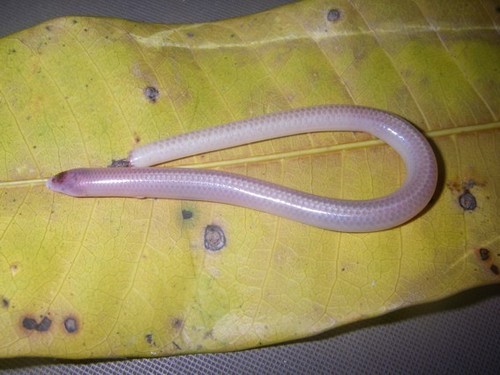
Image (c) Mrs Andolalao Rakotoarison under Creative Commons.
References
- del Cid, Reina [@reinaofthecid]. "big bang #spacepoetry #cosmos #spokenword." Tiktok, 5 April 2023, https://www.tiktok.com/@reinaofthecid/video/7218360917774355754.
- “List of Organisms Named after Works of Fiction.” Wikipedia, Wikimedia Foundation, 4 Apr. 2023, https://en.wikipedia.org/wiki/List_of_organisms_named_after_works_of_fiction.
- Snow, C.P. "The Two Cultures and the Scientific Revolution." Cambridge University Press, New York, 1961.
- Vesna, Victoria, "Toward a Third Culture: Being in-between." Leonardo, Vol. 34, No. 2. (2001), pp. 121-125.
Hi Hearth, I enjoyed reading your blog and especially your opinion on the concept of two cultures. I Specifically, you used the example of a mermaid skink named after a fictional character to show the interaction between arts and science. In my blog, I also discussed on how I find interaction between arts and science in other places. For example, the infusion of AI technologies have revolutionarized the art field, demanding more and more artist to know about AI such as Midjourney or StableDiffusion for better and quicker generation of beautiful artworks. I think it's interesting how the big trend is that artists are relying more and more on technologies to work, instead of the other way around.
ReplyDeleteHello! I really enjoyed reading your blog and I loved your introduction. Poems are such a beautiful way to connect with people. I greatly admire your devotion to both art and science. I especially enjoyed your insert of your breathtaking embroidery that you completed while taking very difficult science courses. I also enjoyed reading about your personal takes on the bridge and divides between the two cultures. Personally I think I have seen a different narrative of politics in art and science but it was really eye opening how you outlined that science and art already have a lot of cross overs. While I was going through the week I focused on the differences and in doing so put blinders on myself to what cross overs already exist.
ReplyDelete